
The Language Beneath Words: Symbol, Myth, and the Unconscious
When I sit with people in moments of grief, transition, or uncertainty, there often comes a point when ordinary language reaches its limits. In these moments, words become too trite, too narrow, or too explanatory. The experience itself resists being neatly named.
It’s often in these moments that something else begins to emerge.
A client might describe an image that keeps returning. It might be a dream fragment or a half-forgotten memory. A sense of being “underwater,” “at a crossroads,” or “carrying something too heavy to set down.” Sometimes a mythic figure or archetypal image arises spontaneously, not as something chosen, but as something already alive in the psyche, quietly offering orientation.
These moments are not digressions from the work I do. They are the work.
Much of my approach to somatic and relational inquiry is rooted in a bottom-up, right-brain process. Rather than trying to think our way into clarity, we slow down and listen for what is already present beneath conscious thought: sensation, image, emotion, metaphor, gesture. This is how the unconscious speaks. Indirectly, symbolically, and often with more nuance than language can hold.
In this sense, somatic work and symbolic work are deeply aligned. Both create conditions where deeper parts of us are invited to speak, rather than being overridden by interpretation, analysis, or the drive for certainty.
Symbolic language has always been one of the primary ways humans have made meaning in times of uncertainty. Long before psychology or neuroscience, people turned to myth, story, ritual, poetry, and divination not to predict the future or explain life away, but to stay in relationship with what could not be controlled or fully understood.
Symbol doesn’t resolve complexity. It holds it.
A myth doesn’t tell us what to do. It offers a landscape we can recognize ourselves within. A symbol doesn’t define experience; it allows experience to breathe. This is especially important in moments of grief, loss, or transition, when the psyche needs space more than answers.
Modern culture often mistrusts this kind of intelligence. We are trained to privilege clarity, speed, hard facts and solutions. We are encouraged to translate experience into actionable, concrete outcomes as quickly as possible. But the unconscious does not operate in a linear way. It expresses through image, repetition, and story, following a rhythm and timing of its own.
This is why insight alone rarely leads to integration.
We can understand something cognitively and still find ourselves living it out somatically, relationally, or emotionally. Symbolic work slows us down in a way that allows meaning to arrive organically, without being forced. It gives the psyche a way to metabolize experience rather than bypass it.
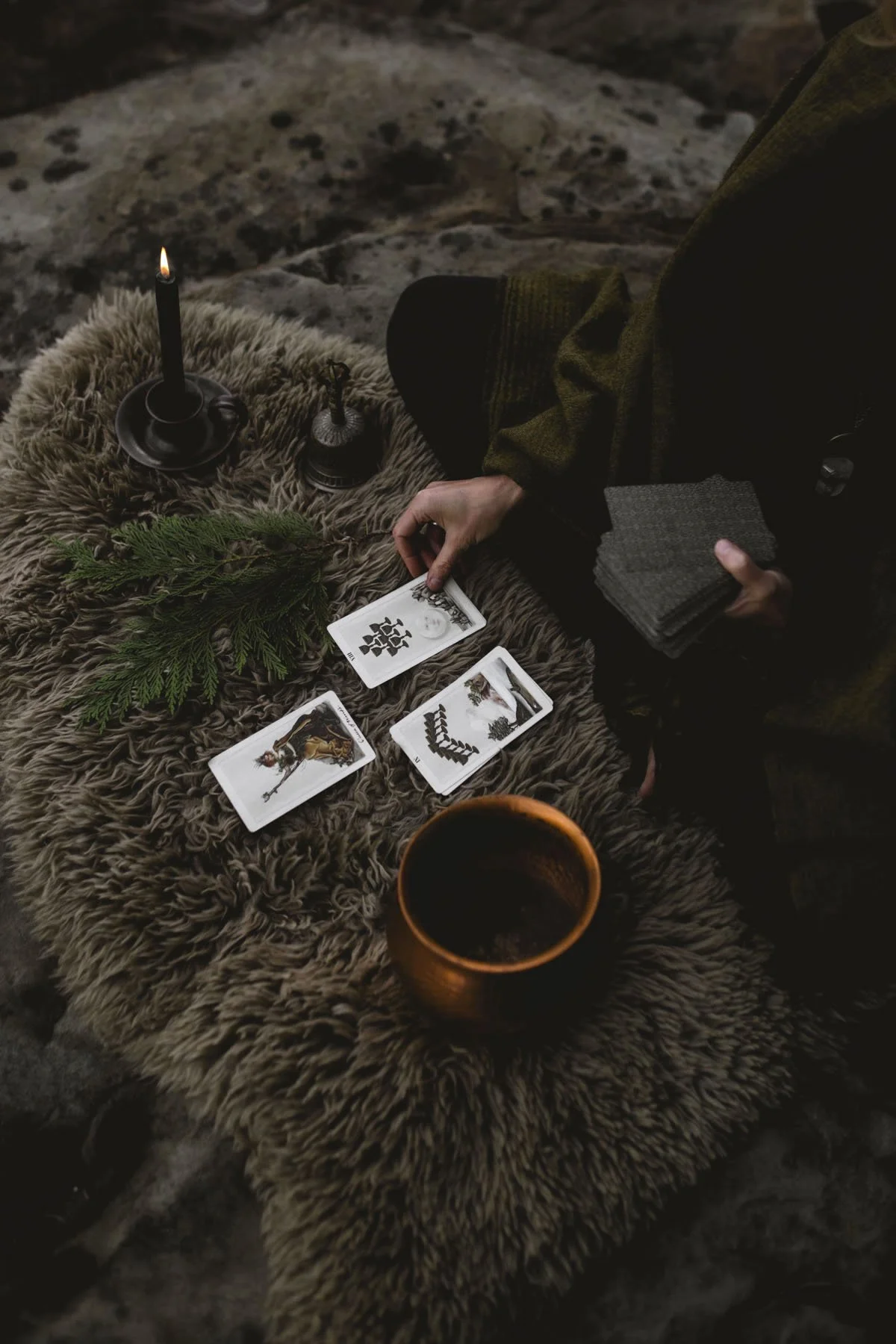
Symbolic tools such as myth, tarot, astrology, and ritual become powerful allies when we meet them as languages of reflection rather than systems of certainty. Their value lies not in prediction or definition, but in their ability to help us listen to what is already unfolding within us.
From this orientation, divination becomes a way of noticing patterns, relationships, and inner movements that are difficult to access through logic alone. Like somatic awareness, symbolic work creates a container where the unconscious can speak without being interrogated, analyzed, or reduced.
Across cultures and throughout time, humans have engaged with these practices for a reason. They meet something essential in us. They offer companionship in the unknown. They remind us that not everything meaningful can be solved, and that some aspects of life are meant to be related to, not mastered.
In my work, whether meaning is emerging through sensation, image, emotion, movement, metaphor, or story, the orientation remains the same: to create space for what wants to be known, without forcing it toward clarity or resolution.
If we allow ourselves to listen in this way, different questions begin to emerge:
What images or stories keep returning in my life right now?
Where does my experience resist explanation but invite relationship?
What symbols feel alive for me in this season, even if I don’t yet know what they mean?
What becomes possible when I stop seeking certainty and start listening for meaning?
These questions don’t require belief. They don’t ask us to suspend discernment or critical thought. They simply invite us to remember that the psyche speaks in many languages, and that symbol is one of the oldest, most human ways we have of staying in conversation with what is deepest and most alive within us.