
Small Acts of Participation
For most of my adult life, I have been working in the territory we now call nervous system health, though for much of that time I wouldn't have used that language. For years, I worked within the language of yoga and Ayurveda, traditions with their own sophisticated and nuanced ways of describing the qualities of mind and body.
These traditions gave me a poetic language for understanding how we move between states of activation and rest, how we resource ourselves, and how we return to balance. Now those same concerns are being addressed through the vocabulary of polyvagal theory, regulation, and the Window of Tolerance, and, in many ways, this translation has made these ideas more widely accessible. But translation always involves some loss, and I find myself noticing what the current conversation sometimes misses.
Much of what has emerged from this conversation is genuinely valuable. Many of us are living under conditions of chronic stress and fragmentation, and learning to ground ourselves, orient toward safety, and reconnect with the body can be profoundly supportive. And yet I find myself wondering whether the conversation has become too narrowly focused on reducing discomfort. If our understanding of healing becomes overly organized around avoiding activation or tightly managing our internal states, we can inadvertently begin shaping our lives around contraction rather than participation.
I have written about some of these ideas in earlier posts here on the blog, so rather than revisiting all of that here, I want to focus more directly on the kinds of practices and experiences that, in my own life, have gently stretched my capacity while also making me more alive, relational, and engaged.
And when I speak about capacity here, I want to be clear that I do not mean it in the sense of becoming more productive or increasingly capable of tolerating unsustainable conditions. In many ways, I think our current culture already asks too much of us. We are often encouraged to override our limits and relate to ourselves as though we should be able to endure ever-increasing levels of stress without consequence.
The kind of capacity I am interested in feels very different from that. It has less to do with endurance and far more to do with our ability to remain engaged with life while staying curious, adaptable, and responsive to what is unfolding around us.
The kind of capacity that helps us stay present while learning something new, remain relational during moments of discomfort or misunderstanding, and tolerate uncertainty, imperfection, contradiction, and change without immediately collapsing, controlling, or withdrawing from the experience.
The Transformative Power of Being a Beginner
Being a beginner can be a powerful way to expand our capacity. Novelty, challenge, uncertainty, frustration, and even manageable failure all stimulate adaptation and growth. There is now a growing body of research showing that learning itself places a healthy degree of stress on the nervous system and brain.
I think this is important to understand, particularly because many of us have become cautious about discomfort. We live in a culture where stress is often chronic and excessive, and so it makes sense that many people are longing for rest, safety, and regulation.
But not all stress is inherently harmful. In the right doses, challenge is actually part of how human beings develop resilience, flexibility, and increased capacity. And learning something new is one of the most accessible ways we can consciously practice this kind of growth.
As adults, many of us quietly organize our lives around preserving our competence. We gravitate toward environments where we understand the rules, know how to present ourselves well, and feel capable or proficient. Over time, it becomes easy to unconsciously avoid situations that make us feel awkward, uncertain, self-conscious, dependent, or visibly inexperienced.
But being a beginner actually brings us into contact with those experiences.
To learn something new requires us to encounter ourselves in a less controlled state. We have to tolerate not knowing. We have to practice making mistakes publicly. We have to remain engaged through frustration, confusion, slowness, and imperfection rather than immediately withdrawing from the experience or turning against ourselves in the process.
In this way, beginnerhood itself becomes a kind of nervous system practice.
Not because we force ourselves into overwhelm, but because we gradually increase our ability to remain open, curious, and responsive in the presence of manageable discomfort.
This is something I have consciously practiced in my own life. In the past seven years alone, I have gone back to school to train as a somatic therapist, learned how to ride a motorcycle, taken up several new forms of needlework, begun a new movement practice through contact improvisation, and, more recently, started learning how to play the guitar. None of these things came naturally to me, and I think that is part of why they have been so valuable.
These experiences do more than simply increase our tolerance for discomfort. They often make our lives larger. They increase our sense of possibility, creativity, adaptability, and participation in the world. They remind us that growth does not end once we become adults, and that there is something deeply enlivening about continuing to learn, experiment, and evolve throughout our lifespan.
Relational Practice & the Capacity to Stay Connected
Relational practices are another potent way to strengthen resilience. Many of us are living in a time of profound relational avoidance, as we increasingly communicate through curated identities, carefully managed online spaces, and social environments where disagreement can quickly feel threatening. Many people are deeply lonely, while also carrying significant fear around conflict, misunderstanding, vulnerability, or relational friction.
And yet, relationships are among the primary places where capacity is built.
Not because relationships are always easy or soothing, but because they continually bring us into contact with difference, uncertainty, rupture, negotiation, and repair.
Practicing difficult conversations with trusted people can be a powerful way of expanding our relational resilience. So can intentional spaces such as authentic relating, circling, group process work, collaborative projects, community organizing, or any environment where we are asked to remain engaged with other humans in real and imperfect ways.
These experiences help us practice things that cannot be learned intellectually, such as how to stay present while uncomfortable, listen without immediately defending, tolerate misunderstanding, repair after disconnection, and remain connected to ourselves while staying in relationship with someone else.
Of course, discernment matters here. Expanding capacity does not mean remaining in harmful or abusive situations, nor does it mean endlessly tolerating relationships that consistently violate our boundaries or dignity.
But I do think many people currently confuse discomfort with danger. And as a result, we may unknowingly organize our lives around avoiding the very relational experiences that help us become more flexible, grounded, and emotionally mature.
Creativity, Play & Improvisation
Perhaps one of the most overlooked forms of capacity building is play. Not performative play, where we are still primarily focused on achievement, but genuine playfulness: experimentation, improvisation, curiosity, creativity, and spontaneous engagement with life.
In recent years, researchers have become increasingly interested in the role of interactive play, creativity, improvisation, and expressive practices in supporting nervous system regulation, learning, emotional flexibility, social bonding, and brain integration.
What we know is that human beings do not only learn through repetition and discipline. We also learn through experimentation, imagination, movement, interaction, and surprise. I think this matters because play naturally places us in a relationship with uncertainty.
When we play, create, improvise, or experiment, we are continually responding to what is unfolding in real time rather than forcing a predetermined outcome. We practice flexibility. We practice adaptation. We practice staying engaged even when we do not fully know what will happen next.
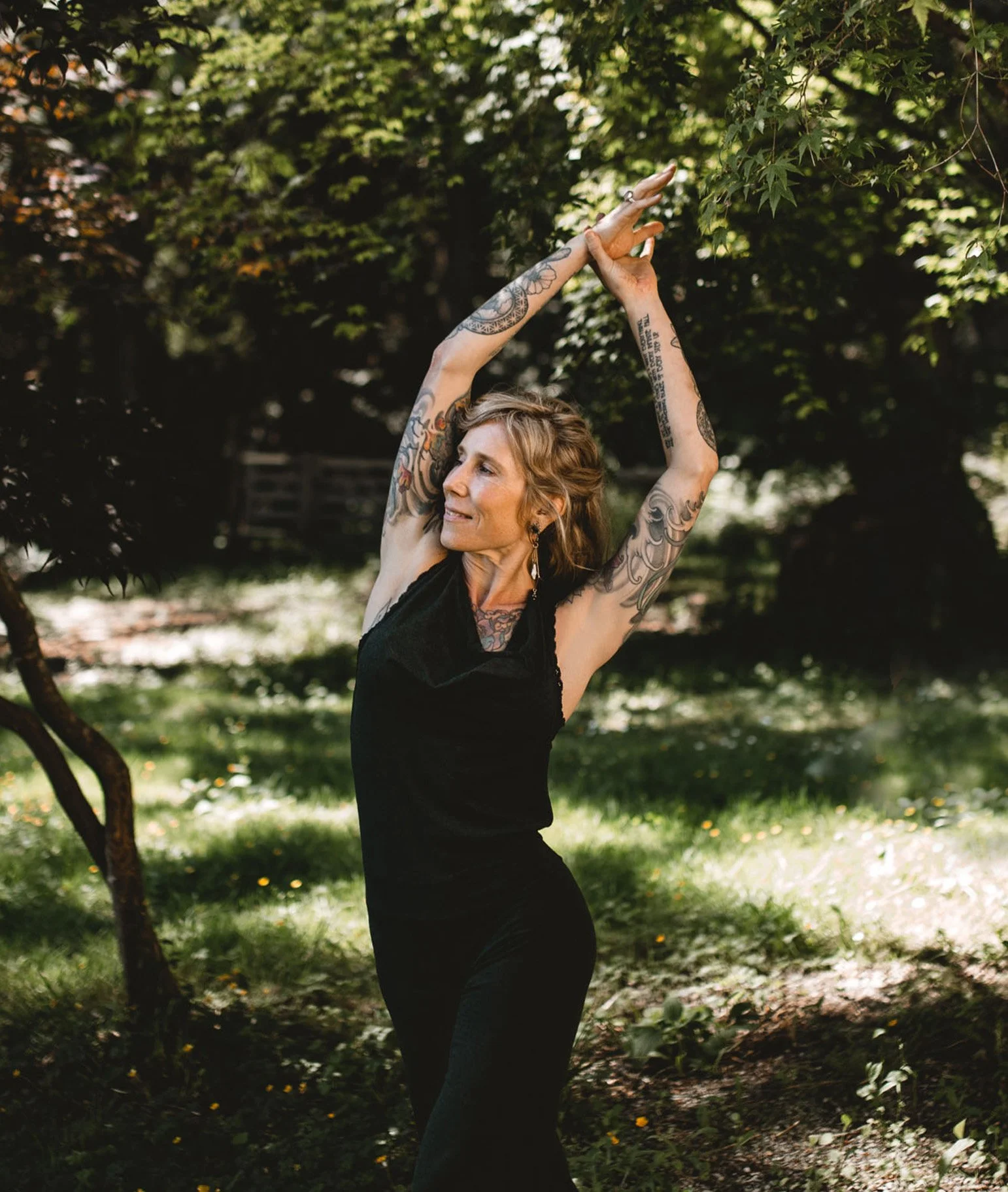
This is one of the reasons I have found contact improvisation dance to be such a profound practice over the past five years.
Contact improv is an interactive form of improvised relational movement rooted in listening, responsiveness, shared weight, touch, momentum, and shared awareness. There is no script to follow and no fixed sequence of movements to memorize. Instead, you are continually responding to shifting conditions in real time through sensation, intuition, communication, and embodied awareness.
I have found this deeply stretching in all the right ways.
It has continually expanded my capacity to tolerate awkwardness, uncertainty, discomfort, visibility, and unknowing. It has required me to remain present while improvising with strangers, navigating moments of misattunement, responding without over-controlling, and learning how to recover from imperfect interactions rather than collapsing into self-consciousness.
And while contact improvisation is one example, I think many forms of creativity and play can offer something similar.
Writing, painting, music, movement, theatre, crafting, storytelling, gardening, collaborative art-making, improvisation games, clowning, dance, and countless other creative practices all invite us into a relationship with emergence. They ask us to loosen our grip on perfectionism and become more responsive to process rather than to outcomes.
This can be especially important for those of us who have spent much of our lives over-functioning, self-monitoring, or organizing ourselves around control and competency. Trauma, chronic stress, and fear often narrow us over time. They constrict our range of expression, spontaneity, experimentation, and relational flexibility.
Play and creativity can help widen us again.
These practices can help restore movement where rigidity has taken hold. They reconnect us with curiosity, imagination, pleasure, experimentation, and aliveness. They help us practice responding rather than controlling.
In a culture that often rewards control, certainty, and performance, there is something deeply restorative about continuing to play, create, improvise, and engage with life in less predictable ways. These practices remind us that not everything meaningful emerges through mastery or control. Some forms of growth only become possible when we loosen our grip a little, allow ourselves to experiment, and remain responsive to what is unfolding in the moment.
Small Acts of Participation
As I bring this to a close, I hope you can take away the message that expanding capacity does not require a dramatic transformation of our lives. Often, it is something we practice through relatively small acts of participation, such as trying something unfamiliar, having a conversation we would normally avoid, making art without worrying about whether it is good, joining a community space, learning a new skill, or allowing ourselves to experiment.
Over time, these experiences can gradually increase our ability to remain open, flexible, relational, and responsive to life itself. And I think that is part of what resilience truly means.
Please know this is something I am continually practicing in my own life. Whenever I notice that I have become overly organized around competency, control, or the avoidance of discomfort, I simply ask myself:
Where have I stopped allowing myself to be new at something?
Where have I become overly cautious about awkwardness, uncertainty, or relational friction?
What forms of creativity, play, learning, or participation might gently widen my world again?