
Animism as Relationship: Listening to the Living World
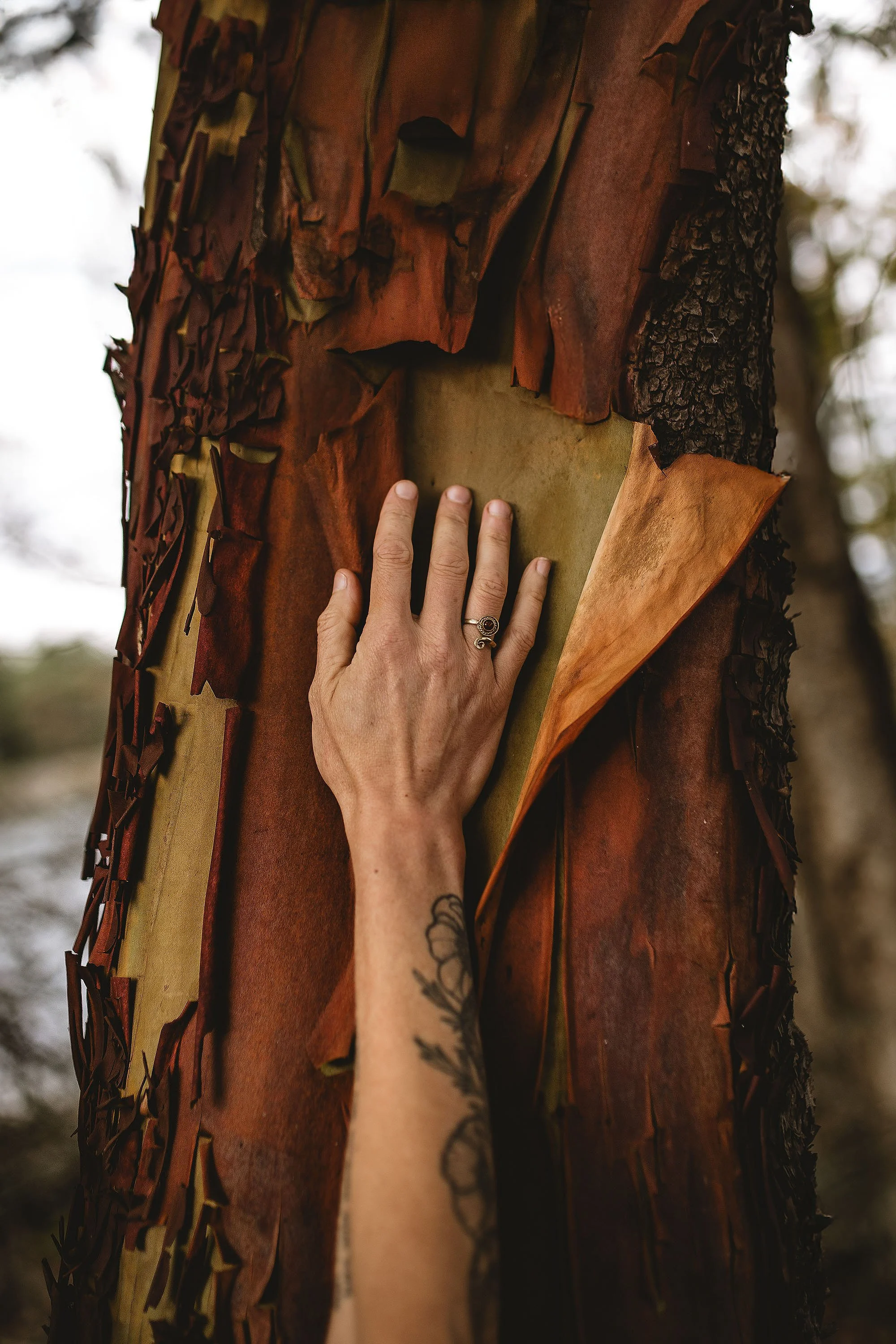
There was a late-summer afternoon, years ago, when I was moving through a season of grief that felt larger than my capacity to hold it. I had been searching for a local species of hawthorn for months — Crataegus douglasii — certain it grew nearby, but unable to find it, no matter how many fields and forest edges I walked.
On that particular day, the grief was heavy enough that I stopped wandering and simply let myself sink down against a small tree in the meadow where I had been wildcrafting. The moment my back met its trunk, something in me softened. I felt held in a way I can’t fully explain, a warm and steady presence that asked nothing of me.
I stayed there for a long while, letting my breath settle, letting myself lean.
And when I finally looked up, I noticed the small dark berries forming above me, and the unmistakable long spines nestled into the bud joints.
Hawthorn had found me.
Not through effort, not through searching, but through a moment of surrender, a moment when I let myself be supported.
For me, animism is the recognition that the world around us is alive and inherently relational. Not metaphorically alive, not symbolically alive, but truly alive in its own ways, communicating through presence, rhythm, timing, and felt experience. Most of this communication is subtle, but subtle does not mean imaginary. It can be profoundly tangible when we slow down enough to notice.
Animism doesn’t ask us to project meaning onto the world.
It invites us to perceive the meaning that is already there.
The land, the weather, the plants, the moon, the shifting seasons, they are all expressing themselves, responding to conditions, influencing our bodies and moods and capacities in ways we feel even when we don’t name them. We are shaped by these relationships, whether we know it or not.
What changed for me on that late-summer afternoon wasn’t that I suddenly became an animist. It was simply a reminder that the world is in conversation with me, and I am in conversation with it - and I can trust that.
Animism, in this sense, is less about belief and more about listening. Less about seeking signs, more about paying attention to the quiet threads of connection that weave us into a world that is already speaking.
How Modern Life Conditions Us Away from Relationship
It’s not surprising that many of us lose touch with this way of perceiving. We live in a culture that trains us to prioritize efficiency over attention and certainty over felt experience. The pace of modern life leaves little room for the quieter forms of knowing, the ones that arise from the body, from the senses, from subtle encounters with the world around us.
Most of us weren’t taught to notice how a place changes with the light, how our bodies shift with the seasons, or how the presence of a particular tree can steady our breath. We weren’t encouraged to treat the world as a companion. Instead, we learned to move through it with a kind of functional detachment, focused on tasks rather than relationships.
None of this is a personal failing.
It’s simply the environment many of us were shaped by, an environment that values extraction over reciprocity, speed over rhythm, and productivity over presence.
But beneath all of that conditioning, the capacity, and the need for relationship remain. Our bodies still register the subtle cues of the world around us, even when our minds are busy. We still orient toward what feels nourishing. We still respond, often unconsciously, to weather patterns, moonlight, birdsong, the scent of the seasons, and the movement of water.
Even if we forget the relationship, the relationship does not forget us.
The world continues speaking in the language it has always spoken.
Animism is simply what happens when we begin to listen again.
Animism and the Body
One of the things I’ve come to trust, both in my own life and in my work with others, is that the body is often the first place where animist knowing returns.
Long before the mind makes meaning, the body senses relationship. It orients toward what feels supportive, softens near what feels safe, becomes alert when something in the environment shifts, and settles in the presence of what feels steady or familiar.
We tend to think of these responses as purely biological — and they are — but they are also relational. The body is constantly in conversation with the world around us, adjusting, responding, attuning. This is part of what creates a sense of belonging, even if we can’t name it at the time.
When we slow down enough to notice these subtle exchanges, the comfort that comes from watching the tide, the uplift that rises with early morning light, we begin to remember something ancient and instinctive: we are not separate from the world we move through.
In this way, animism and somatic practice are deeply intertwined. Both invite us into presence rather than performance. Both trust sensation as a source of wisdom. Both ask us to move at a pace that allows true perception. And both restore us to relationship, with ourselves, with place, with something larger.
For many people, this kind of listening brings a surprising sense of relief. Nothing has to be conjured or imagined. We don’t have to force a connection. We simply allow ourselves to feel the impact of the world that is already touching us.
This is one of the quiet gifts of animist relationship: it softens isolation.
It reminds us that we are supported by more than our own will. It returns us to an experience of belonging that is not dependent on achievement or certainty, but on our willingness to be present to what is here.
If something in you feels drawn toward this way of being, not as an idea to adopt but as a remembering, you don’t need elaborate rituals or special knowledge to begin. Animist relationship starts in the smallest moments of attention.
You might notice the way a particular landscape steadies your breath.
The way your mood shifts when you hear certain birdsongs.
The feeling of companionship in a place you have loved for a long time.
The tenderness that rises with the first signs of a season turning.
None of these moments need to be interpreted or explained. They are simply invitations to slow down, to sense, to participate.
Animism, at its heart, is a conversation: a quiet call and response between your inner life and the living world around you.
If you’d like to explore these relationships more intentionally, you might begin by asking:
Where do I feel a sense of being met, soothed, or steadied by place?
What rhythms am I already influenced by, even if I haven’t named them yet?
What happens in my body when I pause long enough to notice?
There is no right way to approach this. Just a willingness to engage with curiosity, at a pace that feels true for you.
This is the heart of my own practice, and it continues to shape the circles I hold and the way I move through the world. Animism is not a belief system; it is a way of remembering that we are not separate from the living world.
We listen. We respond. We belong.
And each time we return to this conversation, the world meets us halfway.